
Short: the six kinds of data a BigCommerce ERP integration keeps in step: catalog, customer prices, stock, customers, orders with tracking, and invoices.
Read the full write-up: BigCommerce ERP integration
More shorts from this video
 Forrester: 1 in 5 B2B sellers would negotiate with buyers' AI agents in 2026 (0:19)
 What ChatGPT's product feed requires: start with these 8 fields (0:29)
 Why AI agent checkout is not ready for B2B buying yet (0:18)
 ACP, UCP, AP2 or MCP: which agentic protocol should you pick? (0:13)
 What is agentic commerce? The short definition (0:24)
 Custom catalogs and tiered pricing in BigCommerce B2B Edition (0:46)
 Do you need BigCommerce B2B Edition, or is standard enough? (0:46)
 Getting ERP prices into BigCommerce B2B Edition (0:43)
 BigCommerce B2B Edition buyer roles in 30 seconds (0:30)
 4 things BigCommerce B2B Edition doesn't do (0:48)
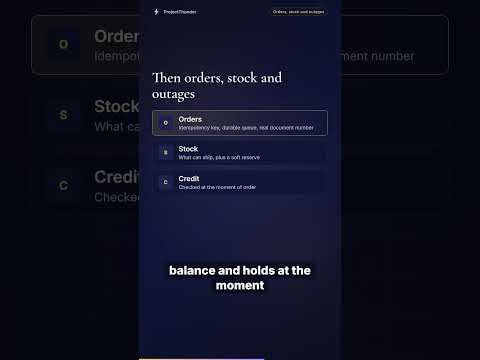 Duplicate orders, stock and ERP outages in BigCommerce (0:42)
 Every ERP has a catch: BigCommerce integration quirks (0:39)
 How to pick a BigCommerce ERP connector: test three hard cases (0:40)
 Why BigCommerce ERP connectors break on pricing (0:44)
 Your business still runs on dBASE files. Now what? (0:30)
 FoxPro indexes in 11 code pages, byte for byte (0:29)
 50 hard power cuts while writing dBASE files (0:33)
 Kill a FoxPro write mid-change: who leaves a silent bad index? (0:41)
 49x faster DBF lookups than the VFP OLE DB driver (0:30)
Transcript
A BigCommerce ERP integration keeps six kinds of data in step between the store and the ERP. The catalog comes from the ERP item master, and customer prices are resolved into BigCommerce price lists. Stock should ideally be available to promise by warehouse, rather than total on hand. Customers move in both directions. Orders go into the ERP as sales orders, with status and tracking coming back. And invoices show up in the buyer's account. One fact shapes all of it. BigCommerce stores its own catalog and price lists, so every integration is a copy kept fresh. The engineering is in how fresh, how correct, and what happens when the copy and the ERP disagree.
Narration is an AI voice (Azure). The facts come from the linked write-up.